

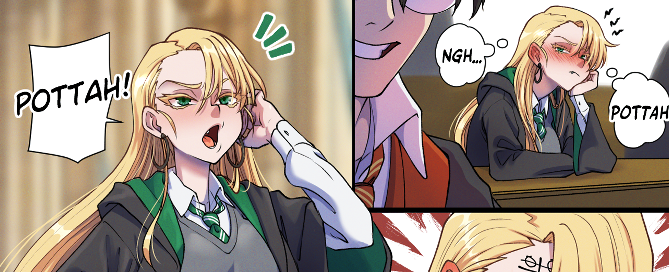
The female version of the Draco Malfoy meme has reignited a debate in my Discord Server (well, Internet): is it wrong to enjoy Harry Potter when we don’t share J.K. Rowling’s views on trans people?
For some people, this reinterpretation is simply an expression of creativity and humor within the fandom. For others, continuing to share Harry Potter references helps maintain the popularity of J. K. Rowling, whose public stance on transgender issues has drawn strong criticism.
I don’t think it is necessarily wrong. To me, the author and the work are two different things. We can enjoy a story, its characters, or its universe without agreeing with the person who created them. After all, a work can end up meaning something very different to its readers than what it originally meant to its author.
Historical examples:
I mean, history is full of examples. Aristotle defended the existence of natural slavery and the inferiority of women; Martin Luther wrote antisemitic texts; and Kant held racist views. Yet, we continue to study their works and acknowledge their contributions. This doesn’t mean justifying their prejudices, but rather understanding that the value of a work doesn’t automatically vanish because of its creator’s flaws.
As far as I’m concerned, if a work doesn’t express its creator’s controversial opinion, I don’t think it’s immoral to enjoy it.
But is it right to provide financial support to the author?:
Of course, there is a difference between enjoying a work and financially supporting the person who made it. It is also legitimate for someone to decide not to consume a work for ethical reasons. Anyone who does not want to contribute financially to Rowling’s success can stop buying Harry Potter products, official merchandise, refrain from recommending the series, or avoid sharing references to it. That decision can be a consistent way to express one’s principles and solidarity with transgender people.
However, a personal decision to boycott does not mean that others must adopt the same stance. I mean, the right to reject a work does not imply the right to impose that rejection. Because it’s also legitimate to continue enjoying a work whose personal significance we find valuable.
One can explain why a franchise is objectionable and invite others to reconsider their consumption habits. What is unreasonable is to assume that everyone who participates in a meme is necessarily supporting the author’s views, or that they deserve to be censored for not joining a boycott.
Let’s not confuse enjoying a work with automatically agreeing with its creator’s polemical opinions.
Sharing a Harry Potter meme doesn’t necessarily mean supporting Rowling opinions, just as reading Lovecraft doesn’t make you a racist. We don’t have to choose between justifying the author and wiping their work off the existence. We can criticize and enjoy.
“Steal” and alter the work:
And this brings up an interesting point to me: what if the fandom appropriates the work and transforms it?
This meme of female Draco Malfoy is a great example. It is a non-canonical reinterpretation that allows fans to play with the character and create something new, without needing to buy official products. In a way, we can “steal” the work from the author (in a cultural sense) giving it new meanings. We can offer a new interpretation of the work, even one that might upset its original author. A sweet form of revenge.
As I like to say: “Author, thanks for creating your work, BUT NOW IT’S MINE, and I’ll do whatever I want with it“
Note: I haven’t read Harry Potter or seen the movies… well, maybe a few random clips, but I’m not a Harry Potter fan.
PREACH!!!
also first!~
i mean honestly in todays attention economy keeping someone relevant is basically giving them money. an authors real power and political influence doesnt just come from royalty checks it comes from them staying famous and talked about. every single meme fan theory and nostalgic repost keeps the whole brand alive in peoples heads. that ongoing hype is literally what gives the creator a huge platform and media voice to do whatever they want. you cant feed the hype train with one hand and then pretend you arent giving the creator more power with the other it just doesnt make sense
But, equally, in the modern world in which we live, it is completely impossible to make a major global phenomenon on the scale of Harry Potter disappear.
As a countermeasure, all we can do is remind people what sort of person Rowling is.